Questo articolo è al momento disponibile solo in inglese.
Hire Dedicated Developers: A Buyer's Guide for US Companies
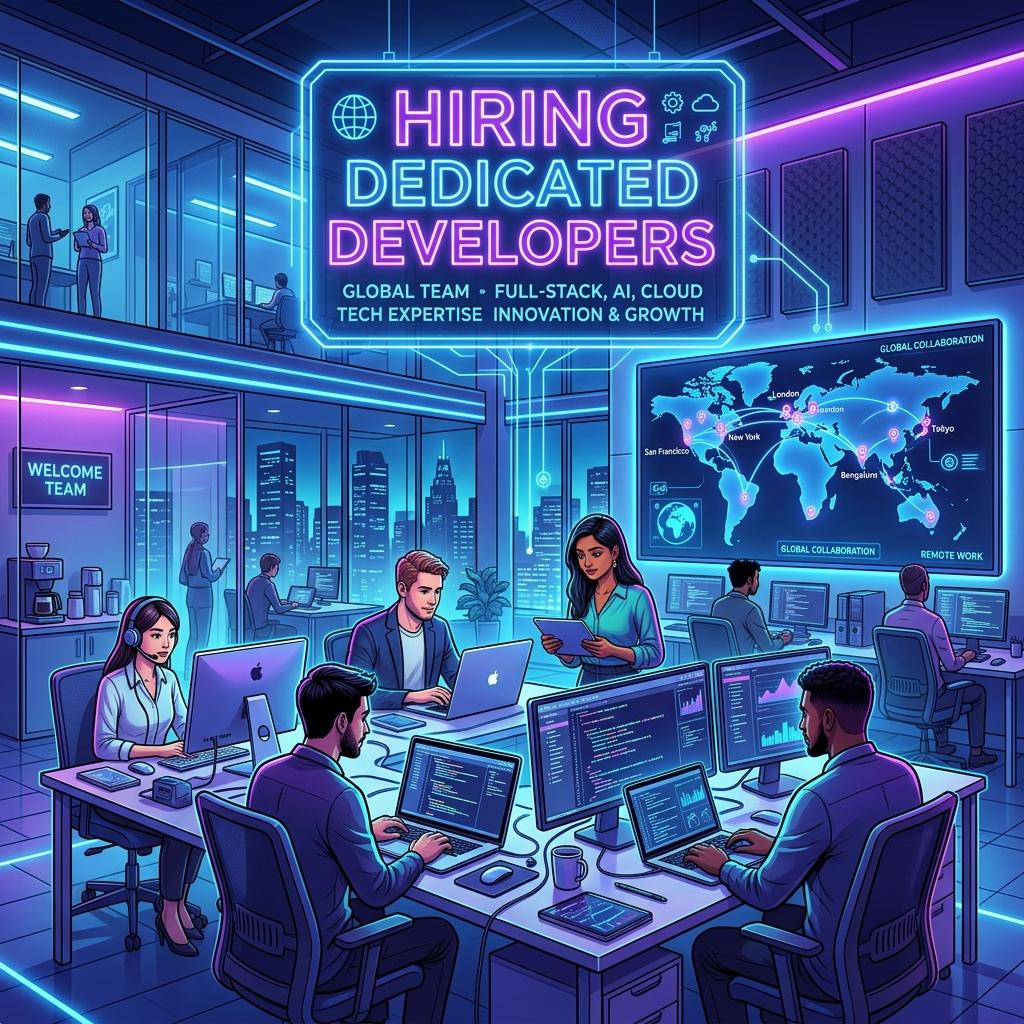
US companies hire dedicated offshore developers to add engineering capacity without the cost and time of local hiring. A dedicated developer works only on your product, full time, for months or years, while the partner company employs them. This buyer's guide covers how the model works, how to vet partners and developers, how to handle the time difference, and what to put in the contract.
What "dedicated" means
- The developer works only on your product, not shared across clients.
- They join your tools, standups and code review, and take direction from your team.
- The partner handles employment, equipment, office, payroll and replacement.
- You pay a monthly rate per developer.
It sits between freelancers (flexible but less stable) and a fully outsourced project (a defined result for a defined price).
When it fits
- You have a product roadmap and someone who can lead the engineering work.
- Local hiring is too slow or too expensive for the roles you need.
- You want people who stay with your codebase long term.
Vetting the partner
- Track record with clients like you, with references you can call.
- Retention: ask about average tenure. Turnover is the biggest hidden cost of offshore teams.
- Security practices: device management, access control, handling of credentials and customer data.
- Contract terms: IP assignment, notice periods, replacement guarantees.
- Transparency: what the monthly rate includes, in writing.
Vetting the developers
- Interview each developer yourself, as you would a US hire.
- Use a short practical task or a review of real code, not puzzles.
- Check written communication: a design explanation or pull request description.
- Ask about the last project they owned end to end.
Handling the time difference
Sri Lanka is 9.5 to 10.5 hours ahead of the US East Coast and 12.5 to 13.5 hours ahead of the West Coast, depending on daylight saving. Teams make this work by:
- Agreeing a fixed one- to two-hour overlap, often early morning in the US and evening in Sri Lanka, for standups and questions. See our guide on time zone overlap with the US.
- Writing clear tickets with acceptance criteria, so work never waits for a call.
- Using the time difference: work handed off in the US evening is reviewed or done by the next US morning.
Contract checklist
- All IP assigned to your company.
- Code, cloud and accounts in your name.
- Confidentiality, and data protection terms if you handle personal data.
- Notice periods to scale up or down (often 30 days).
- A replacement guarantee if a developer leaves or is not a fit.
- Governing law you are comfortable with.
The first 90 days
- Weeks 1 to 2: access, environment setup, pairing and small production tickets.
- Weeks 3 to 6: real features with code review from your team.
- Weeks 7 to 12: ownership of a feature area, and a review of speed, quality and communication.
If it is working, grow the team; if not, address it early with the partner.
Costs
Monthly rates depend on seniority and stack and cover salary, benefits, equipment, office, management and margin. See our pricing breakdown for what to compare between quotes.
Dedicated developers from Mickiesoft
Mickiesoft provides dedicated developers from Moratuwa, Sri Lanka, with agreed overlap hours for US clients. You interview every developer and can start with one. See how to hire developers in Sri Lanka.
Ready to accelerate your project?
Contact Mickiesoft today for a free technical consultation.
Contact UsDomande frequenti
Trova le risposte alle domande più comuni sui nostri servizi, sul nostro metodo di lavoro e sulle nostre competenze.